


In a year defined by rapid change, hybrid work challenges, and shifting expectations of leadership, one coaching topic rose above all others: listening. According to Optify’s analysis of 1,994 coaching goals, active listening appeared in roughly 18% of all goals, making it the single most prominent development priority among leaders in 2024–2025.
That means nearly 1 in 5 coaching goals is explicitly about listening, and many more include it implicitly within communication and feedback goals.
Why? Because leaders are discovering that listening is not a “soft skill” at all; it is the essential foundation of leadership. And the data proves it.
Listening Leads All Coaching Topics
From Optify’s customer data, listening firmly claimed the #1 spot, ahead of Communication Skills, Feedback, Leading Change, and Coaching/Developing People.
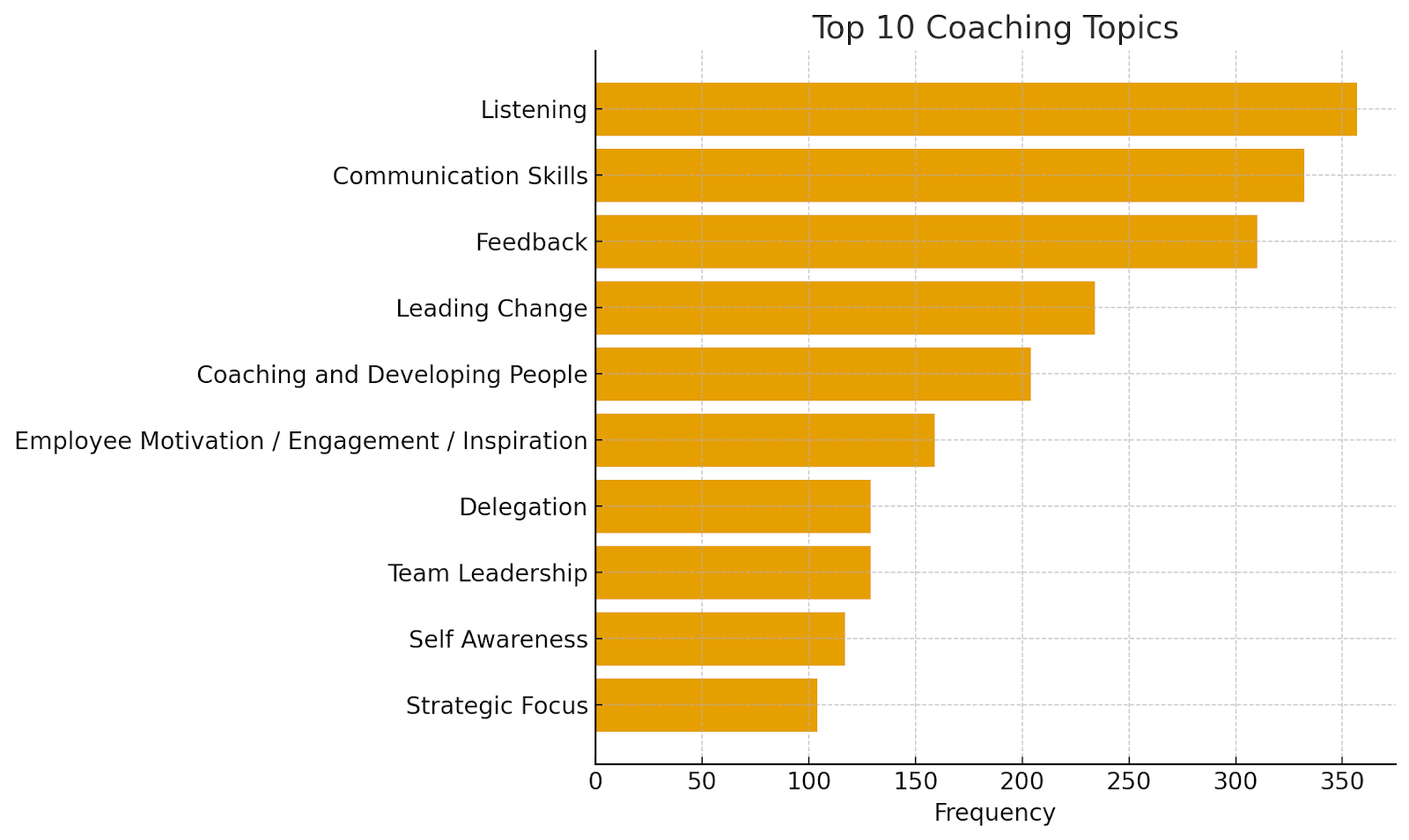
Leaders did not just want to speak better, they wanted to listen better:
- Listening = 18% of all goals
- Communication Skills = 17%
- Feedback = 16%
Combined, more than half of all coaching goals focused on communication-related behaviors.
This is not a coincidence. It is a pattern, and one that has intensified over time.
Why Listening? Because People Can’t Lead Well When They Don’t Understand
1. Listening fuels human-centered leadership
Across programs, leaders described wanting to:
- Understand their teams more deeply
- Communicate expectations more clearly
- Build trust faster
- Reduce misunderstandings
- Strengthen collaboration
The data backs this up: communication and feedback goals almost always appear alongside listening, signaling that leaders see these capabilities as interdependent.
2. It’s important for leaders, their teams, and their organizations
Leaders increasingly operate in environments where:
- Teams are distributed
- Priorities shift quickly
- Engagement is fragile
- Culture must be intentionally maintained
In this context, listening becomes a strategic tool. Leaders who listen well identify risks earlier, inspire commitment more effectively, and create psychological safety, something many leaders explicitly referenced in their goal plans.
3. Change is hard, and listening makes it possible
Periods of organizational transformation require leaders to read the room: to understand resistance, fear, confusion, or fatigue.
In fact, “Leading Change” appeared in ~12% of all goals. Many of those leaders paired change leadership with listening, acknowledging that persuasion and influence require understanding before action.
4. You can’t see yourself clearly on your own
The qualitative data revealed a consistent theme: leaders often do not realize how their communication lands until they hear it reflected back through coaching.
Many goal descriptions captured this sentiment: “I need to listen better so I can understand what my team actually needs.”
Listening becomes the doorway to self-awareness, a supporting theme across 5–10% of goals each year.
The Year-End Surge: When Listening Matters Most
Another key finding: leaders set more coaching goals in November 2024 than in nearly any other month on record: over 200 goals, a 10x increase over typical months.
This surge coincided with new enterprise-wide leadership cohorts and year-end reflection cycles. Listening-related goals spiked at the same time.
Why? Because when leaders enter a new coaching program—or when they reset their sights for a new year—they gravitate toward the fundamentals. And at the top of that list sits listening.
Listening Is Not Passive. It Is Transformational.
The goals leaders wrote were not about “hearing more.” They were about:
- Asking better questions
- Interrupting less
- Responding with empathy
- Making space for dissent
- Clarifying expectations
- Strengthening relationships
- Understanding before directing
This is active listening and it changes everything about how teams experience leadership.
One leader wrote: “I want to listen to my employees and clearly communicate my expectations.”
That pairing—listen → then communicate—appears again and again in the dataset.
The Rise of the Listening Leader
The 2025 data is unmistakable: leaders are redefining what it means to be effective.
Not through authority.
Not through perfect answers.
But through presence, attention, empathy, and curiosity.
Active listening has become the #1 coaching topic because it is the #1 leadership multiplier. It fuels:
- Engagement
- Trust
- Performance
- Innovation
- Team cohesion
- Change readiness
And it creates the conditions under which every other coaching goal, like feedback, delegation, influencing, and leading change, can succeed.
Looking Ahead
If listening was the most important leadership capability of 2025, we predict it will matter even more in 2026.
Organizations are investing deeper and wider in coaching. Leaders are recognizing gaps in communication. Teams are craving connection. And coaching continues to reveal that the fastest path to becoming a better leader starts with learning to listen.
Optify is here to help your leaders listen better in 2026. Connect with us to learn how.