For years, organizations have approached leadership development largely as a collection of programs. A leadership course here. An executive coach there. A new assessment tool. A mentoring program. Maybe a learning platform to tie some of it together.
Each initiative may deliver value on its own. But as organizations face greater pressure to develop more leaders, more continuously, and demonstrate the impact of that investment, the traditional program-by-program approach is beginning to show its limits.
Technology teams learned this lesson years ago. They stopped asking which single tool could solve every problem and started thinking in terms of a technology stack: an interconnected set of systems, platforms, and capabilities designed to work together.
Leadership development needs the same shift.
By 2030, the question for enterprise organizations won’t simply be, “Should we invest in coaching?”
It will be: “What is the leadership development stack we need to identify, develop, support, and measure leaders at scale?”
From Leadership Programs to Leadership Infrastructure
Leaders don’t develop because they attended a workshop in March or completed six coaching sessions over the summer. Development happens over time: through feedback, reflection, practice, coaching, new experiences, reinforcement, and measurement.
Yet in many organizations, the systems supporting those experiences remain disconnected.
Assessment data lives in one platform. Learning content lives somewhere else. Coaching is managed through spreadsheets or a separate provider. Managers have limited visibility into development goals. Measurement often happens after the fact, if it happens at all. The result is a fragmented experience for both leaders and the teams responsible for developing them.
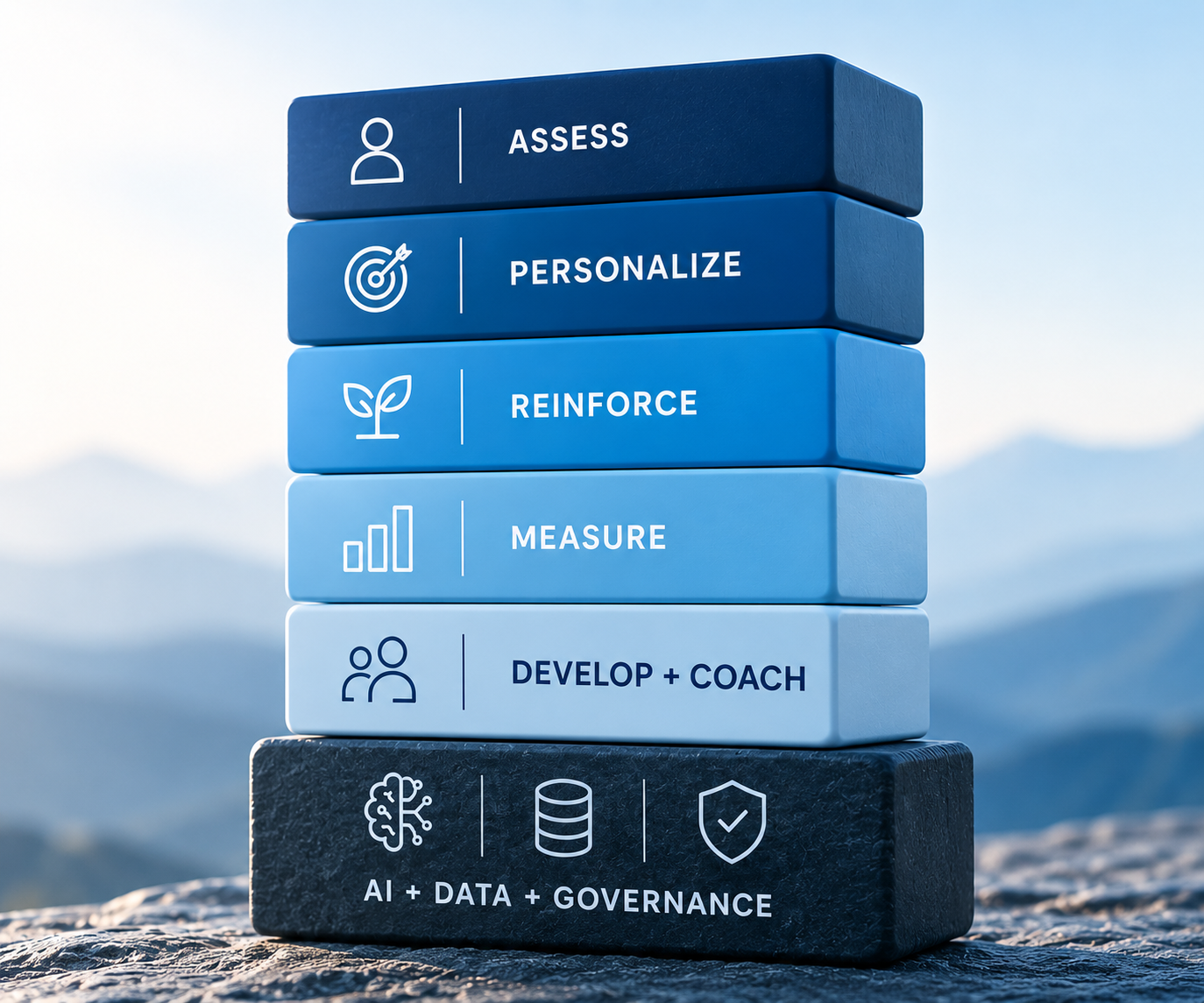
A modern leadership development stack connects those pieces. While the exact technologies will differ by organization, every enterprise should be thinking about six core capabilities:
1. Assess: Where Are Our Leaders Today?
Effective development starts with understanding. Organizations need ways to identify a leader’s strengths, development opportunities, behaviors, capabilities, and readiness for future roles. That might include validated assessments, 360-degree feedback, competency frameworks, performance data, or other organizational inputs.
But collecting the data isn’t enough. The real value comes from turning assessment into action.
A strong leadership development stack creates a bridge between what we know about a leader and what that leader should do next.
2. Personalize: What Does This Leader Actually Need?
Two leaders with the same title may need entirely different development experiences. One may need to become a stronger strategic thinker, another may need help navigating conflict, and a third may be preparing to lead a significantly larger team.
Traditional leadership programs often struggle with this reality because they are designed around cohorts rather than individuals.
Technology changes that equation.
Organizations can increasingly create development journeys that reflect an individual’s role, experience, goals, assessment results, and organizational context, while still operating within a larger enterprise development strategy.
The future isn’t choosing between scalable development and personalized development. It’s finding ways to deliver both.
3. Reinforce: What Happens Between Development Moments?
This may be one of the biggest gaps in traditional leadership development.
Example: A leader attends a workshop, has a powerful coaching conversation, or receives insightful feedback. Then Monday morning arrives. Meetings pile up. Priorities shift. Old habits return.
Development requires reinforcement: opportunities to reflect, practice, receive feedback, revisit goals, and apply new behaviors in the flow of work. That reinforcement might come from a coach, manager, peer group, digital experience, AI-powered tool, or some combination of them.
The important thing is that development doesn’t disappear between scheduled learning experiences.
4. Measure: Is Development Actually Working?
Leadership development has historically been difficult to measure. Participation rates and satisfaction scores can tell us whether people used or enjoyed a program. They tell us much less about whether someone became a better leader because of it.
A modern leadership development stack should make it easier to connect development activity with meaningful progress.
- Are leaders moving toward their goals?
- Are targeted behaviors changing?
- Are capabilities improving?
- Are leaders prepared for more responsibility?
- Are managers seeing a difference?
- Can these changes be connected to the outcomes the organization cares about?
Measurement shouldn’t be something added at the end of a leadership initiative. It should be built into the architecture from the beginning.
5. Scale Coaching: Who Gets Access to Human Development?
Coaching has traditionally been one of the most personalized, and least scalable, components of leadership development. Organizations know the value of high-quality coaching, but historically, providing a coach to hundreds or thousands of leaders created significant logistical and financial challenges.
Technology is changing that.
The right infrastructure can make it easier to manage large coaching populations, match leaders and coaches, coordinate programs, monitor engagement, support multiple coaching modalities, and understand outcomes across the organization.
That doesn’t mean removing the human element from coaching. Quite the opposite.
The purpose of technology should be to make high-quality human development available to more people without sacrificing the quality that makes coaching valuable in the first place.
6. Integrate AI—Responsibly
No leadership development stack built for 2030 can ignore AI.
AI has the potential to dramatically expand what personalized development looks like. It can help leaders reflect between coaching sessions, practice difficult conversations, receive development prompts, identify patterns, access relevant resources, and engage with development at the moment they need it.
But leadership development also involves deeply human and often sensitive information. That makes questions around privacy, transparency, security, bias, governance, and human oversight essential.
The question isn’t simply, “Where can we use AI?”
It’s “Where can AI meaningfully improve development, and where should human judgment remain at the center?”
The strongest leadership development stacks will use AI to amplify human development, not indiscriminately replace it.
What the Modern Leadership Development Stack Looks Like
Put these capabilities together, and a simple model begins to emerge:
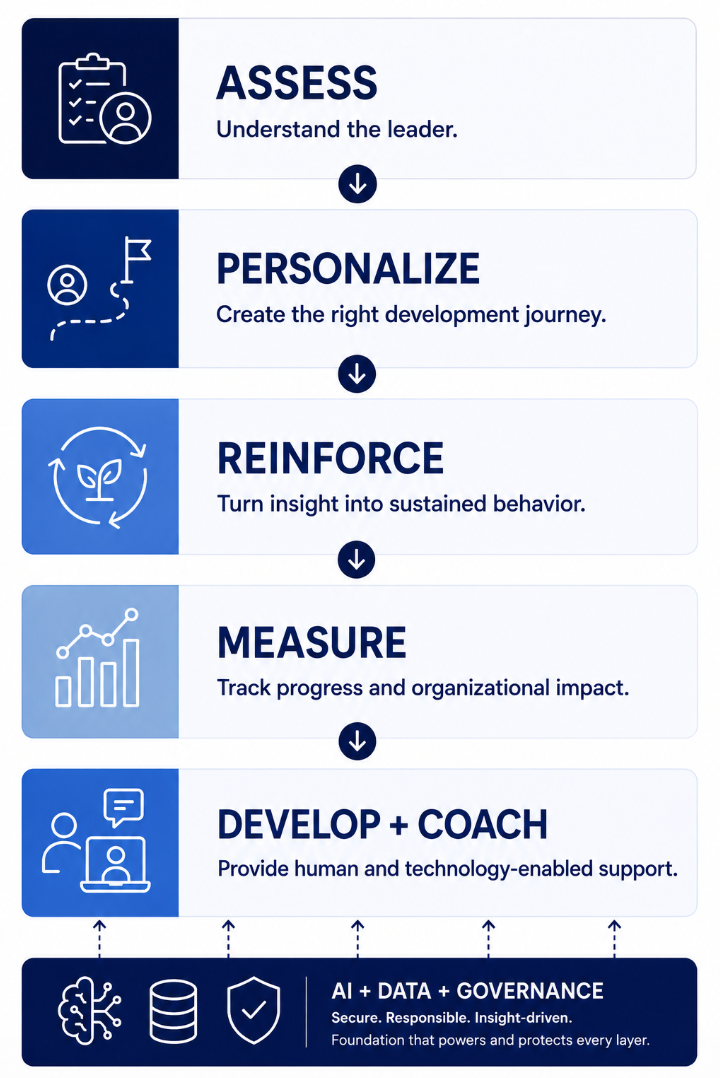
Importantly, these aren’t six independent purchases. The value comes from how well they work together.
Assessment should inform personalization → Personalization should inform coaching and development → Reinforcement should generate signals of progress → Measurement should inform what happens next → Coaching should create goals and actions that can be reinforced → AI should be used to lighten the load without taking away from the human experience.
That’s what turns a collection of leadership programs into a leadership development system.
Building the Stack for What’s Next
2030 isn’t far away.
The leaders who will be running organizations then are already inside companies today. They are managing teams, stepping into bigger roles, navigating transformation, and learning how to lead in an environment that is changing faster than traditional development models were designed to accommodate.
Enterprises don’t need another disconnected leadership initiative. They need the infrastructure to make development continuous, personalized, measurable, scalable, and increasingly intelligent.
At Optify, we believe coaching will remain a critical part of that future, but it won’t exist in isolation. The opportunity is bigger: connecting human coaching, technology, data, and AI into a development ecosystem capable of supporting leaders throughout their journey.
Because the future of leadership development isn’t another program.
It’s a stack.