


Written by Friderike Butler
Coaching Is No Longer Just a Private Conversation
One of my strongest takeaways from ICF Converge Summit in Paris was this: leadership coaching is moving beyond a series of individual sessions into broader ecosystems of learning and transformation, while the field itself is evolving faster than many coaches seem prepared for. The presenters in Paris gave sharper language to what I keep seeing in coaching industry conversations, in the market, and in the wider discourse around AI and human development. AI is accelerating this shift, platforms are supporting it, and organizational expectations are demanding it.
The Field Is Already Being Reshaped
I found the 2026 ICF Converge Conference in Paris truly energizing. Some conversations created productive discomfort. Others opened up entirely new possibilities. Over three days of exploration with speakers, colleagues, and industry leaders, a few dots connected for me.

AI has fully entered the coaching space, even though acceptance, experimentation, and integration still vary widely across the profession. What also came through clearly is that technology in general and AI specifically are moving fast enough that if coaches and coaching service providers hesitate too long, the future of the field may be shaped without meaningful practitioner input.
Panos Malakoudis, Co-Director of Credentialling Standards and Coaching Education Providers for ICF UK, named that risk directly. If we are not engaging and shaping the conversation, it will move forward without us. That warning matters because many in the field still talk about AI as something we can observe, debate, or slow down, rather than something already reshaping the environments in which leadership coaching takes place.
Anna Tavis, Department Chair of Human Capital Management at NYU, spoke clearly about the pressure on the coaching profession. Coaching is increasingly embedded in leadership journeys and experiences at scale. Platforms are surging. AI is simultaneously fragmenting and expanding the field, even as coaching becomes more embedded within leadership development infrastructure.

Coaching remains highly relevant, but the infrastructure in which it sits is changing. So are the ways coaching is delivered inside organizations, the ways its value is understood, and the expectations for how coaching supports both individuals and the systems in which they work.
Deborah Varoqui, Head of Product and Cofounder at Omind Neurotechnologies, explored why scaling coaching is harder than ever, even as AI becomes a powerful partner in the work. That highlighted a tension many organizations are already navigating. They want broader reach, stronger outcomes, more measurable value, and more ethical, psychologically safe ways to scale support. That is much easier to ask for than to build.
Stefan Kreil, Transformation Coach Lead at SAP, emphasized another part of the challenge: AI is accelerating change, and ICF is being called to anchor coaching quality and trust. His framing was practical. AI may be strong in analytical tasks, but it still lacks human empathy, contextual judgement, and discernment. AI can generate options. Humans still need to make decisions.
That requires systems built around human judgment, not systems that bypass it.
Anke Paulick, in her role as President of ICF Germany Charter Chapter e.V., announced that the pilot for a technology platform and AI use assessment with Speexx has been completed. That sets another marker of where the field is heading. Criteria for evaluating coaching technology and AI-enabled coaching services are beginning to take shape.
That matters because quality in coaching is no longer only about the coach’s competence. It is also about the technology, data practices, and systems surrounding the work.
AI Has Put Coaching at Scale on the Table
AI has changed the scale conversation. What once required more coaches, more coordination, more administration, and more cost can now be imagined differently: on-demand reflection, between-session nudges, pattern recognition across time, personalized prompts, stronger preparation, and wider access to developmental support.
Organizations are increasingly looking for integrated transformation support, in-the-moment learning, better visibility, and clearer evidence of impact. They are less interested in isolated coaching packages and more interested in connected environments that support learning, leadership practice, adaptation, and performance over time.
That has implications for all of us. Coaches may need to think more like systems partners, not only practitioners of a craft working with individuals. Team and group coaching will likely grow in importance as organizations look to scale learning across functions and cultures. Many organizations want coaching to become a more integrated part of comprehensive leadership development, and they may not have the bandwidth to build and maintain their own external coach benches.
At the same time, AI coaching as a standalone answer is not enough. Scale does not automatically create depth. More access does not automatically create better development. A platform does not equate acceptance and implementation.
That is where coaching services providers may have an important role to play. Not simply supplying coaches but helping organizations hold the whole architecture: coach quality, ethical guardrails, human oversight, thoughtful AI augmentation, and workflow integration that makes adoption easier without losing the developmental intent.
This shift changes more than the delivery model. It changes the role of the coach.
Before positioning AI and human coaches side by side, we need to get much clearer about what each is actually best qualified to offer. We need to make space for what AI can do well, and perhaps better than humans in some areas. And we need much stronger language for where human perspective, ethical judgment, and discernment provide irreplaceable and essential value.

The Core Challenge Is Trust
As coaching moves into more technology-enabled, data-informed, AI-supported environments, trust becomes the foundation everything else depends on.
Trust in the coach still matters, but it is no longer enough. People also need to trust the systems around coaching. They need to know how data is handled, what remains confidential, how quality is assessed, where human oversight sits and who owns it, and whether technology is being used to deepen development rather than reduce cost, increase surveillance, or make growth appear measurable without making it meaningful. If coaching is going to scale, trust has to scale with it.
This is not a small concern. The private coaching conversation has always depended on a protected space. Clients need to believe that they can be honest, uncertain, unfinished, and still respected. They need room to name what they are wrestling with before feeling pressure to package it into something polished or performative.
When coaching moves into platforms and AI-enabled systems, that protected space becomes more complicated. The question is no longer only “Do I trust my coach?” It becomes “Do I trust the whole environment around this work?” That includes the technology, the organization, the data practices, the business model, the standards, and the human oversight.
If we do not take those questions seriously, we risk scaling something that looks like coaching but does not hold the conditions that make coaching work.
Some Coaching Will Be Easier to Replace Than We Want to Admit
Where coaching remains largely at the level of cognitive support, structured reflection, pattern recognition, or performance-focused problem-solving, AI can already do more than many coaches want to admit.
Those forms of coaching are becoming easier to commoditize because they are repeatable, structured, and more linear than the profession sometimes wants to acknowledge.
AI can bring extraordinary structure. It can synthesize large volumes of information, detect patterns across time, support continuity between sessions, widen access, and make certain forms of reflection more available than ever before. Used well, it can help a leader see themes they were missing, help a coach prepare more rigorously, and make developmental support less episodic.
If a coaching conversation is mostly about helping someone think more clearly, organize ideas, identify patterns, or generate options, we should not be surprised that AI can now do some of that credibly, and in some cases better than human coaching that stays narrow, formulaic, or overly problem-focused.
If we cannot name what is uniquely valuable about human coaching, we should not be surprised when others reduce it to something easier to automate, measure, package, and sell.
Structure is not discernment. Pattern recognition is not wisdom. And access is not the same thing as a human relationship.
Data, however deep, does not tell us what matters most, what should be trusted, what needs to be challenged, what should remain slow, or what kind of human being a leader is becoming in the process.
That is where the human coach and the craft of coaching still matter, and perhaps now matter even more than ever.
Mature human coaches help evoke creative and critical discernment in the client. They support embodied attunement, invite ethical judgment and contextual sense-making, notice what is happening beneath the words, stay with ambiguity, and allow the unexpected to emerge without moving toward an outcome too quickly.
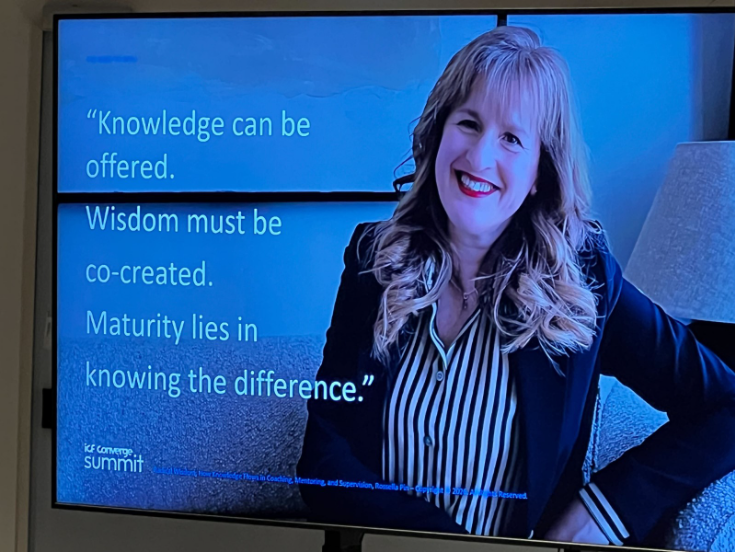
That capacity becomes even more important in a field where AI can provide structure, prompts, synthesis, and pattern recognition at scale. AI has already arrived in the coaching field, but there is still time to shape how it belongs, where it belongs, and under what standards, so it deepens development rather than thinning it out.
The Guardrails Cannot Be an Afterthought
If we are serious about coaching as a force for human development, we cannot only ask how to scale it. We must ask what kind of development we are scaling, under what conditions, and with what protections.
- Are we helping leaders become more conscious, courageous, and responsible?
- Are we protecting the conditions for honesty, reflection, and trust?
- Are we using technology to deepen human growth, or are we making development more efficient while making it thinner?
The answers will be shaped whether coaches participate or not. They will be shaped in platform design, procurement decisions, credentialing conversations, AI product roadmaps, coach education, organizational policies, and the daily choices coaches make about what we will and will not normalize.
Coaches, coaching bodies, platform providers, buyers, educators, and coaching services firms need to be in serious conversation about quality, confidentiality, data use, human oversight, and the conditions that make coaching trustworthy.
We do not need to preserve coaching exactly as it was, but we also cannot allow market speed alone to determine what it becomes. We need to help define the guardrails while the field is still forming.
Because as Anke Paulick challenged us in Paris: if we do not define the quality guardrails for AI coaching, others will.
And they may define them far below the standard the profession, and the people it serves, actually need.